Gardener Millbank: Recycling and Sustainability
 At Gardener Millbank we champion an eco-friendly waste disposal area and a sustainable rubbish gardening area designed for modern urban green spaces. Our approach integrates practical on-site recycling systems with community-driven reuse initiatives. We want to make green waste and household recycling easy, visible and productive by turning garden cuttings, soil and compostable packaging into resources for planting schemes and local allotments. Our commitment is to cut waste to landfill and increase circular resource flows across the site and nearby neighbourhoods.
Our Zero-Waste Ambition and Targets
We have set a clear recycling percentage target: 70% diversion from landfill by 2030. This target covers organic materials, mixed dry recycling and bulky green waste from gardening projects. To meet it we track tonnage and separation rates weekly and publish progress in quarterly sustainability briefs. Targets are ambitious but achievable when combined with better sorting at source, on-site composting bays and coordinated collection routes that prioritise low emissions. The boroughs around Gardener Millbank follow a pragmatic approach to waste separation: kerbside collections for food and garden waste, separate containers for paper, cardboard, glass and cans, and combined residual bins. We align our on-site systems with these local schemes so residents and volunteers find the same sorting logic on-site as at home. This keeps contamination low and ensures recyclable materials enter the correct transfer networks.
We operate a robust network of transfer points and carriers. Local transfer stations we regularly use include the Millbank Transfer Station, the Riverside Transfer Centre and the South Wharf Aggregation Hub. These facilities accept segregated loads for onward processing — organics to composting facilities, mixed dry recyclables to MRFs (materials recovery facilities), and bulky green waste to specialist shredders. Routing to the right transfer station reduces double-handling and helps us keep the carbon footprint of transport low.
Low-Carbon Transport and Collection
Our collection fleet is transitioning to low-emission vehicles. We already operate electric vans for small collections and plug-in hybrid pickups for heavier loads, and we are trialling small hydrogen-assisted trucks for longer routes. Last-mile collections frequently use cargo bikes and e-trikes to move smaller loads between community plots and nearby transfer stations, eliminating the need for short car journeys and cutting emissions from haulage. Fleet routing is optimised to reduce mileage and idling time. To support operational change we invest in staff training on waste separation, contamination reduction and safe handling of compost and soil amendments. Volunteers who help in the sustainable rubbish gardening area receive brief inductions that mirror borough-level recycling rules, keeping systems consistent and improving capture rates for materials like compostable food waste and clean paper/cardboard used in seedling trays.
Partnerships with charities and social enterprises are central to our reuse and redistribution strategy. We collaborate with local food banks, community gardens and social growing projects as well as charities that upcycle plant pots, tools and reclaimed timber for raised beds. These partnerships extend the life of materials and put surplus soil, plants and equipment to immediate community use rather than sending them to disposal. Community Roots and Green Share Collective are among the initiatives we support through donations of surplus compost and seedlings.
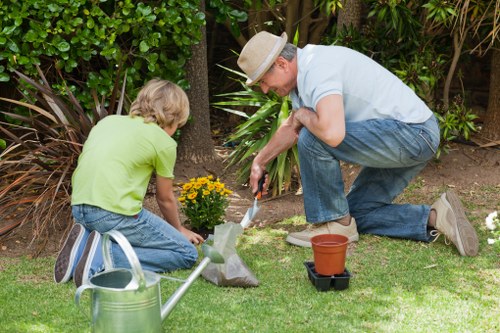 Practical recycling activities on site include:
- Separate bins for glass, cans and mixed paper to follow borough collections;
- Designated organics bay for garden clippings, food waste and compostable packaging;
- Bulky green waste drop-off for shredding and curing into compost;
- Tool and pot reuse shelves aligned with charity collections.
 Sustainability for gardeners at Gardener Millbank also means built-in resilience: rainwater harvesting tanks reduce potable water use, mulching and targeted planting lower maintenance demand, and reclaimed materials are used wherever safe and practical. We emphasise resource efficiency across the landscaping life cycle — from sourcing to disposal — and apply circular principles so that waste from one process becomes feedstock for another.
Monitoring and continuous improvement underpin our work. We measure tonnage per waste stream, contamination levels and vehicle emissions to adjust operations. Regular audits help us refine signage and bin placement, and we report progress toward our 70% recycling target each quarter. Policies also reflect local policy: when boroughs change collection types or introduce new recyclable categories we adapt quickly to stay aligned and maintain high capture rates.
Gardener Millbank welcomes collaboration that strengthens circularity and reduces carbon. We continue to expand our network of low-carbon van operators and community partners, and we explore new opportunities for on-site processing, such as tumblers for rapid composting and small-scale anaerobic digesters for energy recovery from garden food waste. Our sustainable rubbish gardening area is built to scale with responsible disposal and reuse at its core.
By combining practical recycling infrastructure, strategic partnerships, low-emission transport and alignment with borough waste separation schemes, Gardener Millbank delivers a replicable model of urban horticultural sustainability. Join us in making waste a resource through considered separation, reuse and low-carbon collections — helping the city become greener and more resilient.